
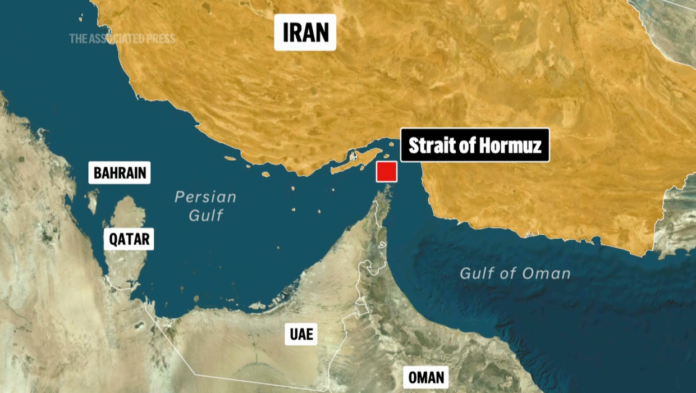
Oman Strait of Hormuz trade impact has become a major concern for regional shipping and energy markets. Iran recently announced new conditions for vessels passing through the strategic waterway. This decision creates both cautious optimism and serious uncertainty for Oman’s trade sector.
In Oman, maritime and business sectors closely monitor developments in the Strait of Hormuz. Iran informed international maritime authorities that it will allow “non-hostile” ships to pass. However, the definition excludes vessels linked to the United States and Israel. Therefore, shipping companies face new operational risks and unclear navigation rules.
Iranian officials stated that only neutral or non-aggressive vessels may transit safely. They emphasized that ships must avoid any involvement in hostile activity. As a result, shipping operators now reassess routes that pass near Oman’s maritime corridor.
In addition, the Strait of Hormuz remains one of the world’s most critical energy routes. It handles a large portion of global oil and gas shipments. Therefore, any restriction directly affects trade stability in Oman Strait of Hormuz trade impact scenarios.
Furthermore, shipping activity has already dropped significantly. Many tanker operators suspended movement through the strait due to security concerns. As a result, congestion increased near key maritime entry points. Reports also show hundreds of vessels waiting outside the region.
Analysts say Iran aims to signal control without declaring a full blockade. They believe this approach allows selective passage while maintaining political pressure. Therefore, uncertainty continues to shape shipping decisions in the Gulf.
At the same time, business leaders in Oman express concern about regional trade disruption. They warn that unstable maritime rules may affect fuel imports and exports. In addition, they highlight risks to logistics planning and insurance costs. Oman Strait of Hormuz trade impact therefore extends beyond shipping into wider economic planning.
Experts say the situation could influence long-term investment decisions. Companies may reconsider routes or delay expansion plans. However, some analysts suggest that partial reopening may eventually stabilize traffic if tensions ease.
In addition, Oman continues to emphasize maritime safety and regional stability. Authorities encourage diplomatic solutions to restore predictable trade flows. They also stress the importance of secure navigation for global energy supply chains.
Oman Strait of Hormuz trade impact remains closely tied to regional geopolitical developments. As conditions evolve, Oman’s trade sector continues to face both opportunity and risk in a highly sensitive maritime environment.
