
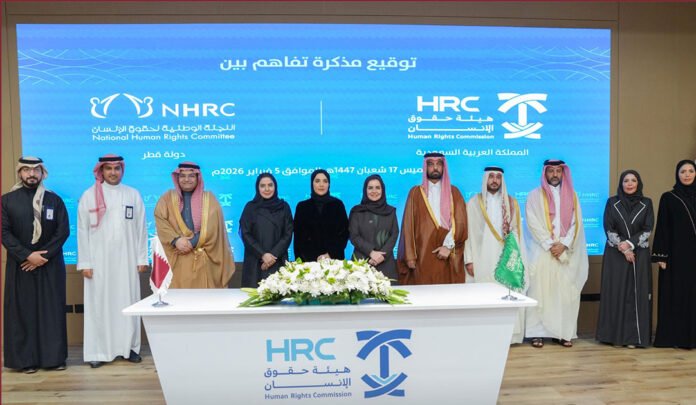
Human rights cooperation between Gulf nations advanced as Qatar’s National Human Rights Committee (NHRC) signed a technical MoU with Saudi Arabia’s Human Rights Commission (HRC). The agreement strengthens joint efforts to protect rights, promote justice, and raise awareness across the region.
The MoU was signed by NHRC Chairperson Mariam bint Abdullah Al Attiyah and Saudi HRC President Hala bint Mazyad Al Tuwaijri. It focuses on technical collaboration, capacity building, and launching joint programs. Both institutions aim to improve societal awareness. They also want to consolidate principles of justice, equality, and mutual respect.
Al Attiyah emphasized that human rights cooperation enhances Gulf partnerships. It allows for sharing best professional practices. She also highlighted that technical collaboration develops institutional performance and improves service quality. It also supports ongoing training for specialized personnel. The MoU opens avenues for knowledge exchange and joint initiatives to protect rights and freedoms.
The agreement outlines multiple areas of collaboration. These include specialized training programs, exchanging research, publishing results, as well as organizing seminars, workshops, and conferences. Authorities will also exchange information, statistics, and publications. They will focus on the rights of women, children, the elderly, and persons with disabilities.
The MoU aligns with national legislation in both countries. This ensures effective implementation. Officials stressed that coordinated activities will create a unified Gulf model for managing human rights challenges. The pact will enter into force after completing legal procedures in both states. It will also continue for several renewable years.
Additionally, Al Attiyah met with the Saudi Judicial Training Centre’s director-general. They explored integrating human rights topics into training for judges and lawyers. They also discussed sharing programs, joint workshops, and innovative solutions. These aim to enhance judicial performance and rights protection.
Through these initiatives, Gulf nations aim to strengthen legal standards and reinforce justice. They want a sustainable and integrated regional human rights system. Both institutions emphasized that human rights cooperation plays a crucial role in building societal respect, fairness, and long-term regional stability.
