
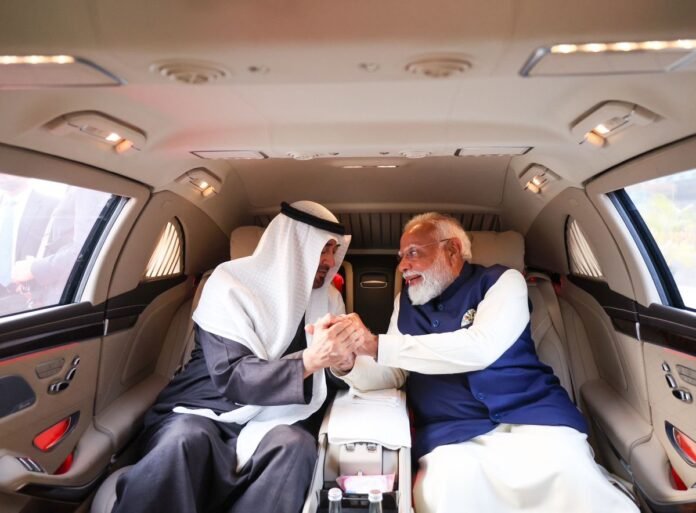
The UAE used a short presidential visit to reinforce long-term strategic goals. Although the visit remained brief, its message carried strong intent. Moreover, the UAE highlighted its growing commitment to India as a core partner. Therefore, the UAE signaled confidence, clarity, and direction through action.
The UAE has steadily reshaped its relationship with India. In the past, energy and labour dominated cooperation. However, the UAE now prioritizes broader engagement. Today, defence, manufacturing, technology, and innovation guide policy. As a result, the UAE–India strategic partnership reflects a long-term vision.
Importantly, the UAE positions this partnership as independent and balanced. It does not align against any country. Instead, the UAE promotes cooperation based on mutual respect. Furthermore, Emirati leadership emphasizes stability and pragmatic diplomacy. Consequently, the partnership supports regional calm rather than rivalry.
Economic strategy drives much of the UAE’s approach. The UAE continues to expand trade ties with India. At the same time, Emirati investors deepen exposure to Indian infrastructure. Ports, logistics hubs, and industrial corridors attract strong interest. Therefore, the UAE channels capital toward sustainable growth markets.
The Comprehensive Economic Partnership Agreement strengthens this direction. It offers predictability for Emirati businesses. Moreover, it improves access to India’s expanding consumer base. As a result, UAE companies pursue manufacturing, digital platforms, and supply chain investments.
The UAE–India strategic partnership also supports diversification goals. India offers scale and resilience during global uncertainty. Meanwhile, the UAE brings financing, connectivity, and global reach. Thus, the UAE secures long-term economic insulation through partnership.
Energy cooperation remains central to UAE planning. Oil exports still matter, yet strategy continues to evolve. The UAE now works with India on gas, reserves, and clean energy. In addition, both sides invest in renewables and green technologies. This approach balances present needs with future transitions.
Security considerations also influence UAE policy. Regional instability across West Asia raises investment risk. Therefore, the UAE seeks stable partners outside conflict zones. India offers political continuity and strategic autonomy. As a result, the UAE strengthens defence and maritime cooperation.
Military coordination and intelligence sharing now feature prominently. These areas once received limited attention. However, trust and shared interests changed priorities. Consequently, cooperation now supports regional security objectives.
People-to-people ties further reinforce the UAE’s strategy. A large Indian community contributes to economic life across the Emirates. Likewise, tourism flows continue to grow. These links enhance social and economic resilience.
The UAE–India strategic partnership demonstrates that focus matters more than duration. The visit emphasized outcomes over protocol. Therefore, the UAE advanced its regional and global objectives efficiently.
Overall, the UAE continues to position itself as a forward-looking economic power. Deepening ties with India strengthens diversification, stability, and global relevance. Consequently, this partnership will likely shape future Emirati strategy.
