
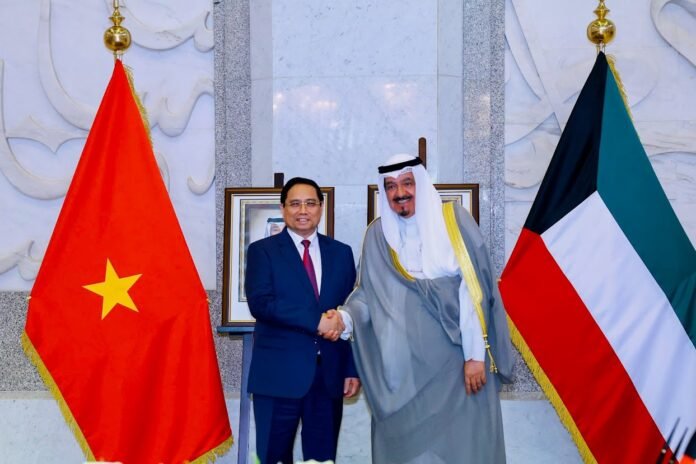
Kuwait and Vietnam announced a strategic partnership for cooperation, reflecting strong mutual trust and a commitment to long-term collaboration. The partnership focuses on economy, education, innovation, technology, governance, and human resources. Moreover, it aims to strengthen people-to-people ties and expand joint initiatives across multiple sectors.
Vietnamese Prime Minister Pham Minh Chinh visited Kuwait for the first high-level leadership visit in 16 years. The visit coincides with the 50th anniversary of diplomatic relations between the two nations. During a lecture at the Saud Nasser Al-Sabah Kuwait Diplomatic Institute, the Prime Minister described Kuwait as a loyal friend and important partner. He emphasized that mutual trust and aligned positions have long anchored Vietnam-Kuwait relations.
The two countries identified nine priority areas for cooperation. These include political trust, high-level exchanges, non-traditional security, technology, energy, food security, trade, investment, and youth development. The Prime Minister noted that economic ties do not yet reflect the available potential. Therefore, this strategic partnership for cooperation aims to unlock new trade and investment opportunities while expanding cultural, educational, tourism, and research initiatives.
Vietnam-Kuwait energy collaboration was highlighted through the Nghi Son Refinery and Petrochemical Complex. Kuwait Petroleum International holds a 35.1 percent stake in the $9 billion joint project, which processes up to 200,000 barrels of Kuwaiti crude oil daily. This venture marks Kuwait’s first major downstream investment in Southeast Asia.
The Prime Minister also discussed Vietnam’s domestic development, including recovery from war and sanctions, landmark economic reforms in 1986, and the pursuit of a socialist-oriented market economy. He outlined Vietnam’s long-term vision to become an industrialized, high-middle-income nation by 2030 and a developed, high-value economy by 2045. Innovation, education, technology, and youth development remain key pillars to achieve these goals.
Furthermore, the Prime Minister emphasized the strategic importance of the Middle East and Kuwait’s role in promoting stability, peace, and dialogue. He praised Kuwait’s COVID-19 support, including a donation of 600,000 vaccine doses to Ho Chi Minh City.
During the visit, the Vietnamese delegation toured Al-Salam Palace Museum, exploring Kuwait’s history and heritage. The visit reinforced bilateral ties and highlighted opportunities for future collaboration under the new strategic partnership for cooperation.
This agreement sets a solid foundation for long-term collaboration, advancing diplomatic, economic, and social ties between Kuwait and Vietnam.
