
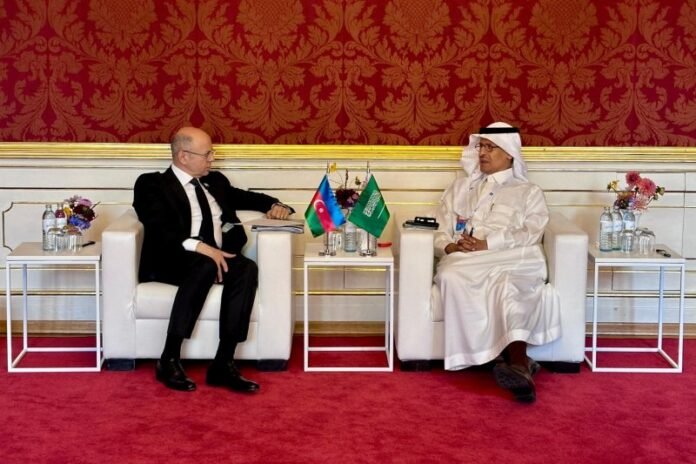
Azerbaijan and Saudi Arabia have taken significant steps toward offshore wind energy collaboration during high-level talks in Vienna. The discussions focused on a massive 3.5 GW offshore wind project, signaling a strong commitment to renewable energy expansion.
Azerbaijani Energy Minister Parviz Shahbazov met with Saudi Arabia’s Energy Minister, Prince Abdulaziz bin Salman Al Saud, to explore joint energy initiatives. “We held productive talks on our bilateral energy agenda,” Shahbazov stated in a social media post. The ministers reviewed ongoing partnerships, including a 240 MW wind power plant and the proposed 3.5 GW offshore wind venture.
The offshore wind energy collaboration aligns with both nations’ goals to diversify their energy portfolios. Azerbaijan, known for its oil and gas reserves, is increasingly investing in renewables. Similarly, Saudi Arabia is advancing its Vision 2030 objectives by expanding clean energy projects. This partnership could position both countries as leaders in sustainable energy.
While hydrocarbon cooperation remains important, the focus on wind energy marks a strategic shift. The 3.5 GW offshore project could significantly boost renewable capacity in the region. Additionally, the ministers discussed the Joint Technical Commission’s role in facilitating energy innovation.
The Vienna meeting set the stage for further technical and financial discussions. If realized, the offshore wind initiative would be one of the largest in the region. Experts believe this offshore wind energy collaboration could attract further international investments in green energy.
Minister Shahbazov emphasized the broader implications of the talks. “Our cooperation extends beyond traditional energy sectors,” he noted. With Saudi companies already involved in Azerbaijan’s hydrocarbon projects, this new venture strengthens economic and environmental ties.
As global demand for renewable energy grows, Azerbaijan and Saudi Arabia are positioning themselves at the forefront. Their offshore wind energy collaboration could serve as a model for future cross-border sustainable energy projects.
