
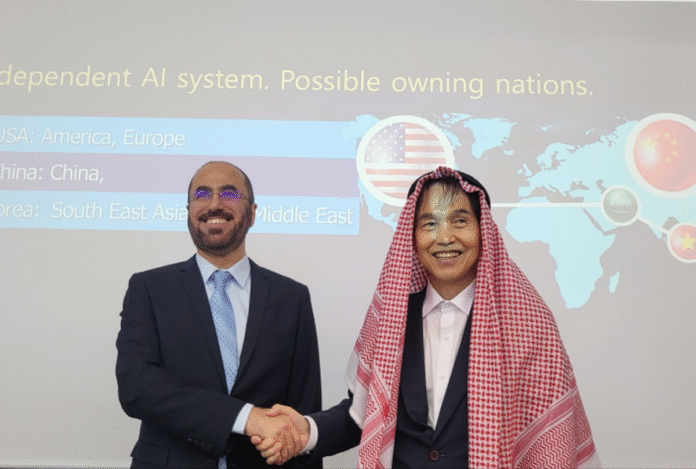
A landmark partnership between Korea and Saudi Arabia could reshape the global AI landscape while creating new opportunities for African nations. On July 3, KAIST and King Saud University agreed to collaborate on open-source AI development, aiming to establish a third-way AI model beyond U.S. and Chinese dominance.
The agreement, signed at KAIST’s Seoul campus, focuses on building an open-source-based AI alliance across MENA, Japan, Korea, and Southeast Asia. Significantly, this initiative could extend to Africa, offering emerging economies access to cutting-edge AI technology.
KAIST President Kwang Hyung Lee has long advocated for a third-way AI model to break the U.S.-China tech duopoly. “Our collaboration will foster cooperative coexistence in AI,” Lee stated. Meanwhile, King Saud University’s President Abdulla Al-Salman emphasized Saudi Vision 2030’s role in driving this innovation.
Saudi Arabia brings vast investment capabilities and digital infrastructure, while Korea contributes advanced AI research and semiconductor expertise. Together, they plan to:
- Co-develop open-source AI models
- Launch dual-degree graduate programs
- Expand academic and researcher exchanges
- Establish a joint AI research center
This partnership aims to create a third-way AI model that prioritizes accessibility and inclusivity. By avoiding proprietary restrictions, the alliance could empower African nations to participate in AI development.
The deal aligns with growing demand for neutral, open AI solutions. KAIST and King Saud University will soon formalize their agreement with an MOU, followed by joint research initiatives. Additionally, the Korea Foundation’s support ensures long-term sustainability.
President Lee highlighted the strategic vision: “This alliance will diversify the AI ecosystem beyond existing power structures.” With Africa’s tech potential, this collaboration could unlock new opportunities for global AI equity.
