
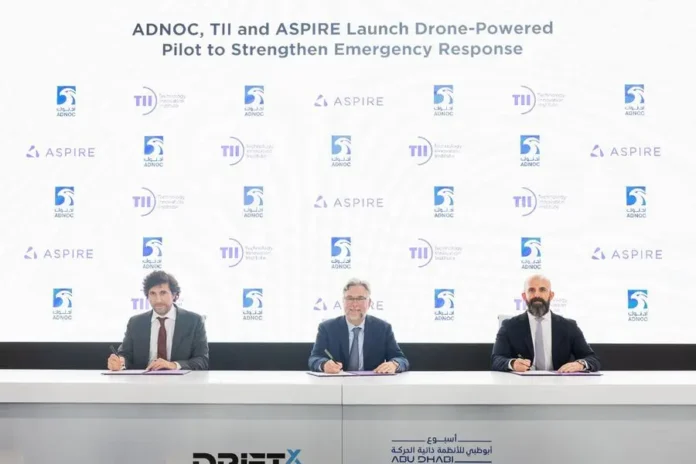
The UAE has launched a new real-time aerial monitoring system to improve emergency response and save lives. This system allows authorities to act quickly during disasters, protecting people across the country.
The Technology Innovation Institute (TII), working with ADNOC and supported by ASPIRE, developed the system. It unites long-range autonomous drones using swarm technology into one easy-to-control network. As a result, drones can work together efficiently and provide immediate updates during emergencies.
Drones can launch instantly from ADNOC sites, sending live video to control centers whenever an incident happens. Moreover, for remote or large-area emergencies, long-range drones can launch from special hubs. Smaller drones support these operations, creating a real-time aerial monitoring system that covers the country quickly.
During major incidents, drone swarms can scan large areas in minutes. They locate people in danger, send critical information, and maintain communication with rescue teams. This technology reduces response times while keeping first responders safer.
TII said the project will continue in phases to improve reliability. Authorities will test drone routes, data transmission, and swarm coordination. Once fully deployed, the real-time aerial monitoring system will be a key tool for UAE emergency services, strengthening disaster readiness and response.
Experts said this advanced drone system is a big step for public safety. It shows how the UAE leads in using new technology to protect residents. Furthermore, it highlights the country’s commitment to innovation in saving lives and supporting emergency teams.
Officials noted that the project is part of a wider plan to modernize emergency services. By combining AI, autonomous drones, and swarm coordination, the UAE can respond faster, reduce risks, and use resources more efficiently during crises.
With this new network, the UAE sets a global example in emergency response technology. The real-time aerial monitoring system promises to change disaster management and keep communities safer than ever.
