
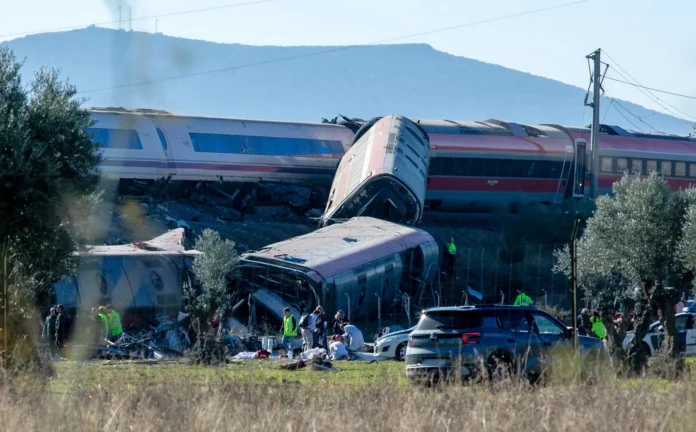
A deadly Spain train collision killed at least 30 people in central Spain on Wednesday, with authorities warning the death toll could rise. Emergency teams rushed to the scene as passengers escaped from the wreckage near Urda, south of Madrid.
The crash occurred shortly before 9am in Castilla-La Mancha, around 130 kilometres south of the Spanish capital. According to regional authorities, two high-speed trains collided, leaving damaged carriages scattered across the tracks and a nearby embankment.
Images from the scene showed the scale of the destruction as rescue workers searched the wreckage. Some shaken passengers reportedly carried their suitcases away from the trains while emergency crews began assisting those affected.
Authorities initially reported ten deaths before later raising the confirmed toll to at least 30. However, regional government spokeswoman Esther Padilla warned that the number could increase as rescue operations continued. Officials had not yet provided a confirmed figure for the injured.
Spanish emergency services deployed extensive resources to manage the disaster. These included several fire crews, three helicopters and two mobile intensive care units. Meanwhile, railway officials suspended the main high-speed route connecting Madrid with southern Spain.
State-owned railway operator Renfe confirmed that one of its services had suffered a collision involving a train operated by private company Iryo. However, authorities had not announced the cause of the crash or explained the circumstances leading to the impact.
The Spain train collision also disrupted the country’s political agenda just weeks before an early general election scheduled for November 29. Prime Minister Pedro Sanchez said he felt shocked by the tragedy and offered support to victims and their families.
Sanchez cancelled his appearance at a Madrid summit focused on obesity after news of the disaster emerged. His Socialist Party also suspended its campaign activities, while condolences arrived from political leaders across Spain and Europe.
Spain’s royal household expressed concern for those affected and thanked emergency personnel responding to the incident. European Commission President Ursula von der Leyen said Europe mourned with the victims, while French President Emmanuel Macron conveyed France’s solidarity.
The disaster has renewed scrutiny of railway safety in a country known for its extensive high-speed rail network. Spain has invested heavily in the system, which ranks among the world’s largest after China’s.
However, Wednesday’s crash follows another deadly collision near Adamuz in January, when 46 people died. That disaster raised serious questions about railway safety and infrastructure on the route connecting Madrid with Seville.
The January accident marked Spain’s deadliest train disaster since 2013, when a derailment near Santiago de Compostela killed 80 people. Both major crashes this year occurred along the Madrid-to-Seville corridor, one of Spain’s busiest rail routes.
The high-speed line opened in 1992, becoming the country’s first route of its kind. Investigators now face the task of establishing what caused Wednesday’s collision, while rescue teams continue responding to the aftermath.
As authorities assess the damage and gather information, passengers and families await further details about those involved. Officials have yet to announce a final death toll or provide a timeline for restoring normal rail services.
