
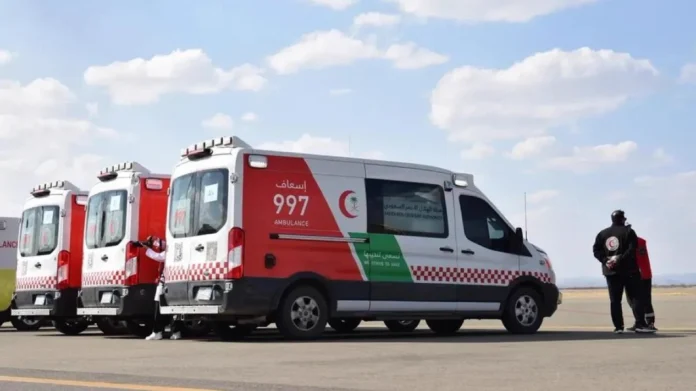
The Saudi Red Crescent Authority has strengthened its emergency preparations across Makkah region, placing 166 ambulance teams on standby ahead of the rainy season. The deployment aims to help crews reach medical emergencies quickly as forecasts warn of moderate-to-heavy rainfall across several governorates.
The authority has positioned 69 ambulance teams in Jeddah, 60 in Makkah, and 37 in Taif. Additionally, six specialized response vehicles will support coverage and help reduce the time required to reach patients.
The authority has also coordinated its preparations with the National Center for Meteorology. Teams monitor weather forecasts and updates, while officials adjust ambulance positions according to conditions and areas requiring additional coverage. Consequently, the deployment supports emergency medical services during periods of severe weather.
These measures form part of operational plans designed to maintain services under different weather conditions. Meanwhile, the authority continues preparing ambulance crews and coordinating with other agencies to strengthen emergency response capabilities. This approach helps medical teams remain ready as rainfall changes local travel and safety conditions.
Makkah region already relies on an extensive ambulance network that operates around the clock. The network includes 98 centers divided across 19 ambulance sectors, serving Makkah, Jeddah, Taif, and surrounding areas. Makkah has 38 centers across eight sectors, while Jeddah operates 36 centers across seven sectors. Taif has another 24 centers serving four sectors.
During heavy rainfall, the authority can reposition crews near locations where emergency calls may increase. These areas include valleys, major highways, crowded districts, and rugged terrain across affected governorates. Furthermore, command-and-control and medical dispatch centers monitor developing conditions in real time. They then coordinate responses and direct resources toward areas with the greatest needs.
Jeddah requires particular attention because its geography increases the risk of flash flooding. The city sits below an escarpment and has at least 11 wadis that channel water toward urban areas. Therefore, intense rainfall can create hazardous conditions that complicate road travel and emergency access.
The National Center for Meteorology has forecast moderate-to-heavy rainfall across Makkah and several nearby governorates. The forecast covers Al-Kamil, Al-Jumoum, Bahra, Taif, Maysan, Adham, Al-Ardiyat, Al-Laith, and Al-Qunfudhah. In response, Civil Defense officials have urged residents to take precautions and follow relevant safety guidance.
The authority’s emergency workload remains substantial even outside severe weather periods. During the first quarter of 2026, ambulance teams handled 122,186 emergency calls across Makkah region. These included 61,868 calls in Makkah city, 46,949 in Jeddah, and 13,369 in Taif.
Additionally, the authority conducted 92 air-ambulance missions during the same period. Its specialized heart attack and stroke-response procedures also handled more than 450 cases. These figures demonstrate the continuing demand for emergency medical services across the region.
Red Crescent Readiness therefore combines additional ambulance coverage, weather monitoring, and coordination with other emergency agencies. The preparations aim to protect residents and visitors while maintaining access to urgent medical care during periods of heavy rain.
The authority has urged citizens and residents to cooperate with ambulance crews and give emergency vehicles sufficient space. People should report medical emergencies by calling 997 or using the official Asefni mobile application. Callers should also provide an accurate location so dispatchers can guide crews to the incident quickly.
As the rainy season approaches, officials continue monitoring forecasts and adjusting operational resources as conditions develop. Residents should follow Civil Defense guidance, avoid hazardous flooded areas, and contact emergency services when medical assistance becomes necessary.
The preparations reflect the importance of maintaining reliable emergency services during challenging weather. Red Crescent Readiness is intended to help ambulance crews respond efficiently as rainfall increases risks across Makkah region.
