
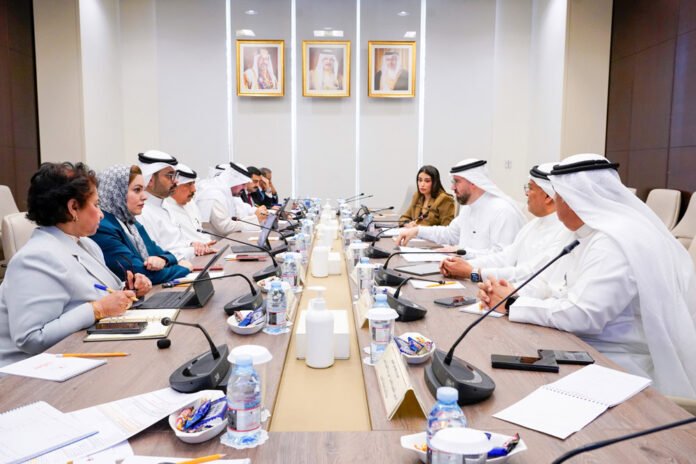
The Finance and Economic Affairs Committee moved forward with important discussions aimed at strengthening economic governance during its meeting on Wednesday morning. Lawmakers stressed the need for clear coordination with the Bahrain Chamber of Commerce and Industry because both sides seek more transparent rules for government tenders. The committee also emphasized that strengthening economic governance supports long-term national development.
The committee held the meeting under the leadership of Ahmed Sabah Al-Salloum and attended by all members. They welcomed the First Vice President of the Bahrain Chamber of Commerce and Industry, Khalid Mohammed Najibi, along with several representatives from the Chamber. The meeting focused on significant legislation that could reshape key economic procedures in Bahrain.
Lawmakers reviewed amendments to Decree-Law 36 of 2002, which governs tenders, auctions, purchases, and sales. They also examined an additional draft law that changes the schedule determining voting power inside the Chamber based on members’ capital. The Chamber and the committee explored each detail carefully because both sides want to ensure fairness, clarity, and stronger institutional standards.
Committee members stressed the importance of consistent dialogue with the Chamber. They also highlighted that continued cooperation promotes transparency and improves business confidence across the country. Moreover, they explained that these amendments help modernize legislation to match national development goals.
The discussion included detailed feedback from Chamber representatives. They raised several points about improving tender procedures and ensuring smoother participation for private sector companies. Lawmakers valued this input because it helps shape practical solutions for complex economic issues.
The committee includes several active members who contribute to these discussions. Members include Zainab Abdul Amir Khalil, Iman Hassan Shwaiter, Basma Abdul Karim Mubarak, Abdullah Hassan Al-Dhaen, Mohammed Mohammed Al-Rifai, Mohammed Yousef Al-Maarefi, and Najib Hamad Al-Kuwari. Their combined expertise supports broad policy review and continuous legislative development.
Furthermore, the committee plans additional meetings to finalize recommendations before sending the legislation to the full House. They aim to reach decisions that align with national priorities and ongoing economic reforms. They also want to ensure that business institutions benefit from clearer frameworks and more efficient processes.
Overall, the meeting marked another step toward strengthening economic governance in Bahrain. Lawmakers and Chamber representatives showed strong commitment to cooperation, continuous improvement, and transparent procedures. Their shared efforts reflect a unified approach toward building a stronger economic environment.
