
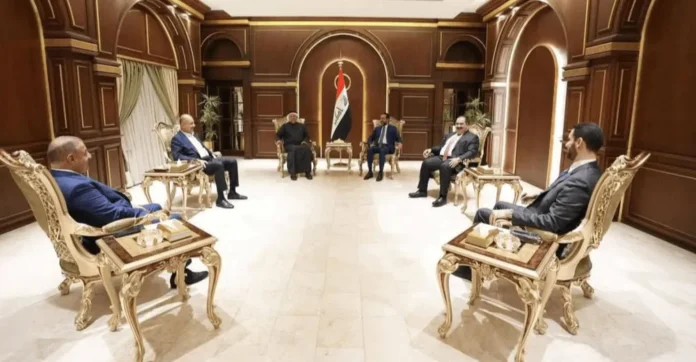
Iraq’s parliamentary speaker race has reached a critical stage as Sunni political forces intensify coordination efforts. Following the ratification of election results, negotiations in Baghdad gained momentum. Political leaders now prioritize unity over rivalry. The goal centers on presenting a single candidate with broad acceptance. This approach aims to strengthen Sunni representation within the new parliament.
Talks took place under the framework of the National Political Council, which brings together Sunni blocs that won seats in the 2025 elections. These groups include Taqaddum, Al-Siyada, Al-Azm, and Al-Hasm al-Watani. Each bloc entered discussions seeking influence while avoiding internal division. Therefore, leaders focused on shared criteria instead of individual ambitions. This strategy reflects growing awareness of the risks of fragmentation.
During a key meeting in Baghdad, council leaders discussed standards for selecting a unified nominee. They also negotiated how to distribute parliamentary and cabinet roles based on electoral performance. Initially, six candidates competed for the position. However, continued dialogue narrowed the list to three names. As a result, attention shifted toward candidates with wider political reach.
Among those remaining, Muthanna al-Samarrai gained noticeable support. Participants cited his moderate political stance and stable relations across Sunni factions. Moreover, several leaders considered him acceptable to Shiite and Kurdish blocs. This factor carries significant weight within Iraq’s consensus-driven system. Consequently, Iraq’s parliamentary speaker race increasingly depends on cross-bloc understanding rather than internal dominance.
At the same time, Mohammed al-Halbousi formally entered the race. Sources confirmed that he submitted his candidacy during council discussions. He aims to return to a role he previously held. Thabet al-Abbasi also remains in contention, maintaining his position within the reduced field. Despite competition, leaders continue to emphasize dialogue over confrontation.
Negotiators also addressed the political value attached to key positions. They discussed an informal points system used to assess influence. According to sources, the speaker role carries higher political weight than most cabinet posts. Sovereign ministries rank slightly lower in comparison. Other portfolios would follow proportional representation within parliament. These calculations continue to shape bargaining dynamics.
Meanwhile, constitutional deadlines add urgency to the talks. The National Political Council previously urged the president to set a date for parliament’s first session. The constitution requires lawmakers to convene within fifteen days of result certification. During that session, parliament must elect a speaker and deputies. Subsequently, the process moves toward choosing a president and nominating a prime minister.
As consultations continue, leaders expect to finalize a nominee within ten days. Once selected, the candidate will be presented to Shiite and Kurdish parties for approval. This step aims to secure smoother passage during the formal vote. Ultimately, Iraq’s parliamentary speaker race highlights the central role of compromise. It also reflects the balance between political ambition and collective stability in Iraq’s evolving landscape.
