
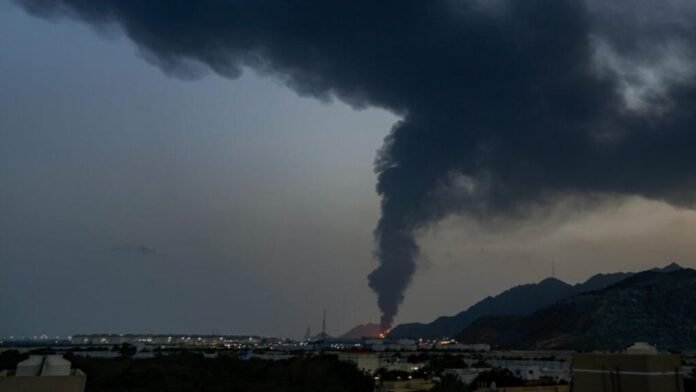
Rising regional tensions continued Sunday as Iranian drone attacks targeted key infrastructure in Kuwait and Bahrain. The strikes marked another escalation in the Gulf conflict, which has intensified over the past week. Kuwaiti authorities confirmed that drones targeted fuel storage tanks at Kuwait International Airport. The attack triggered a fire near airport facilities. However, emergency teams quickly controlled the blaze before it spread further. Officials said no serious injuries occurred during the incident. Nevertheless, the strike raised new concerns about protecting vital infrastructure across the Gulf region.
Meanwhile, Kuwait’s interior ministry reported that two border guards died while carrying out national security duties. Authorities did not immediately provide details about the circumstances surrounding their deaths. At the same time, Kuwait’s military confirmed it responded to several incoming drones and missiles. Defense systems intercepted many of these threats before they reached populated areas. However, falling debris from interception operations caused minor damage to some civilian facilities. Authorities also reported damage to the country’s main social security building in Kuwait City. As a precaution, officials suspended public visits to the building while engineers assessed the damage.
In addition, Kuwait’s national oil company announced a precautionary reduction in crude oil production. Officials said the step aimed to protect facilities while security forces monitored the evolving situation. Across the Gulf, governments increased security measures around energy sites, airports, and industrial facilities.
Meanwhile, Bahrain reported a separate strike on critical infrastructure. Authorities confirmed that Iranian drone attacks damaged a desalination plant responsible for supplying water to parts of the country. Officials accused Iran of targeting civilian infrastructure without discrimination. However, Bahrain’s national communication office said the attack did not affect water supplies or network capacity.
Additionally, falling missile debris injured three people and damaged a university building in the Muharraq area. Emergency teams quickly secured the site and treated the injured individuals. Officials also inspected nearby structures to ensure public safety.
Elsewhere in the region, several Gulf countries reported additional threats during the same period. Saudi Arabia said its air defenses intercepted dozens of drones targeting areas near Riyadh. Defense officials confirmed that interception systems neutralized the threats before they caused damage.
The United Arab Emirates also reported that its air defenses responded to incoming missile and drone threats. Qatar confirmed that it intercepted several missiles fired toward its territory earlier.
Despite these attacks, Iran’s leadership recently attempted to calm tensions with neighboring countries. However, Iranian officials later warned that strikes could continue against locations used for attacks against Iran. As a result, security forces across the Gulf remain on high alert.
Governments throughout the region continue strengthening defenses to protect infrastructure and civilian areas from further Iranian drone attacks.