
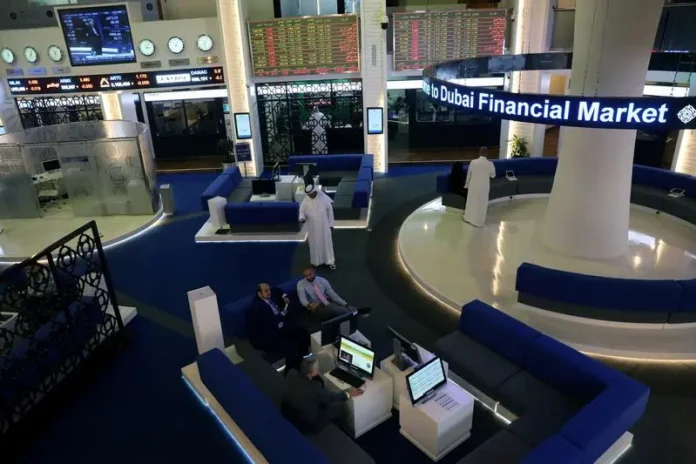
The UAE continues to experience rising UAE equity market volatility as regional tensions impact investor sentiment. Analysts warn that prolonged conflict could deepen uncertainty across financial markets. As a result, investors remain cautious and closely monitor developments.
Recent trading sessions show continued declines across major indices. The Dubai Financial Market and the Abu Dhabi Securities Exchange both recorded notable losses. These declines reflect a broader reaction to geopolitical risks rather than fundamental economic weakness.
Moreover, analysts highlight that the ongoing conflict linked to Iran continues to influence market behavior. As tensions persist, investors increasingly shift toward safer strategies. Consequently, many reduce exposure to risk-sensitive sectors.
In particular, real estate stocks have suffered the most significant losses. Major developers such as Emaar Properties and Emaar Development saw sharp declines. This trend reflects heavy selling pressure driven by uncertainty and risk aversion.
At the same time, analysts note that volatility has increased across multiple sectors. Industries tied to global trade, tourism, and finance remain especially vulnerable. Therefore, aviation, banking, and property sectors face continued pressure.
However, experts emphasize that the UAE maintains strong economic fundamentals. The country’s fiscal position and infrastructure development continue to support long-term stability. As a result, markets may avoid a prolonged downturn despite current fluctuations.
In addition, recent declines have created selective opportunities for long-term investors. Some analysts point to attractive valuations in financial and other sectors. Because of this, investors with a long-term outlook may find entry points in quality stocks.
Meanwhile, UAE equity market volatility continues to shape short-term strategies. Investors now prioritize capital preservation and risk management. This cautious approach reflects uncertainty surrounding the duration of the conflict.
Furthermore, analysts warn that extended instability could impact the broader Gulf region. Financial markets across interconnected economies may face similar pressures. Therefore, regional confidence depends heavily on the resolution of geopolitical tensions.
UAE equity market volatility remains closely tied to developments in the conflict. While the economic outlook stays resilient, uncertainty continues to influence market movements. As conditions evolve, investors will likely remain cautious until stability returns.
