Jeddah sculptures by Spanish artist Julio Lafuente have become familiar features of streets and squares across the city. Around 30 installations from his work help shape Jeddah’s distinctive public landscape.
Lafuente, an artist and architect, worked with Jeddah Municipality during the 1970s. His projects formed a major part of the city’s “Beautification of Jeddah” initiative. As a result, residents and visitors encountered art in everyday public spaces.
The sculptures offered more than visual interest. They also helped people recognize locations and navigate the city before digital maps became common. Over time, those practical reference points grew into landmarks associated with Jeddah’s shared memories.
Among the best-known pieces, the 15-metre “Bicycle” stands out for its large iron structure. Its unusual scale and design have made it a recognizable feature for generations of residents.
Another prominent work, “The Globe,” stands north of King Abdulaziz Road. Lafuente used glass and colored concrete to represent Makkah’s central place in the Islamic world. Meanwhile, four lantern sculptures along Al-Andalus Road draw inspiration from traditional Mamluk-era lamps.
Lafuente also incorporated religious and cultural references into several works. One sculpture faces the Grand Mosque and uses marble lines and geometric shapes to express Islamic identity. Another combines bronze, marble and Arabic calligraphy around a Qur’anic verse.
These details show how the artist connected his designs with local surroundings. He used materials and visual references that linked each piece to its setting. Consequently, the artworks became part of how people experienced the city, rather than objects separated from daily life.
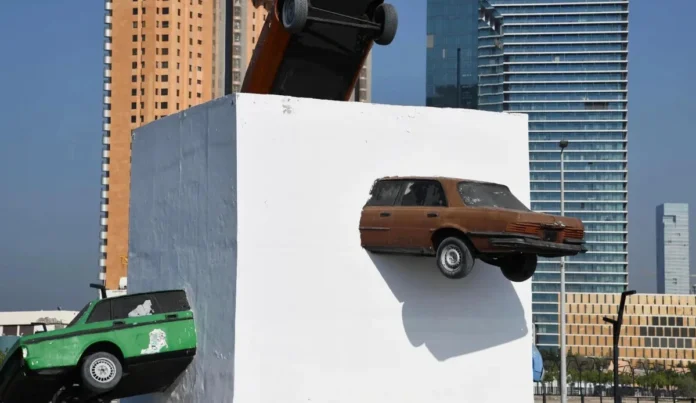
Some installations also carry direct public messages. “Reckless Speed,” for example, places five real cars inside a concrete cube. The striking composition warns drivers about speeding and dangerous behavior on the road.
Beyond sculpture, Lafuente contributed to Jeddah’s built environment through architecture. He designed the former Literary Club building, which now houses the Saudi Arabian Society for Culture and Arts.
Today, the installations remain visible reminders of an important period in Jeddah’s urban development. They connect artistic expression with local culture, religious references and public awareness. Jeddah sculptures continue to shape the city’s visual identity and collective memory.