
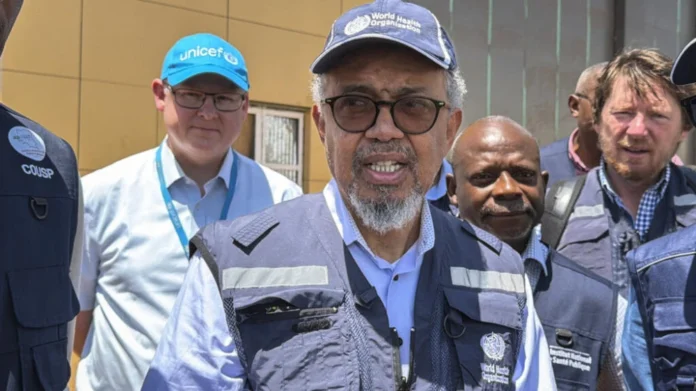
Ebola team evacuation in eastern Democratic Republic of Congo followed three days of sheltering at a hospital amid intense fighting. WHO Director-General Tedros Adhanom Ghebreyesus said staff left the facility in Akwe, Ituri province, under difficult circumstances.
The group included personnel from the World Health Organization, Congo’s health ministry and partner organizations. They had taken refuge at the hospital as fighting continued nearby. Because insecurity increased, the WHO temporarily relocated its Ebola response team until conditions improve.
Ituri sits at the center of Congo’s current Ebola outbreak. The country has recorded 11,762 cases and 5,775 deaths, making this its largest outbreak to date, according to the WHO. The virus has spread across parts of eastern and northeastern Congo, regions that have endured decades of violence.
Tedros said attacks had become more frequent since late October, disrupting efforts to contain the outbreak. The relocation therefore affects teams working to support the response, although officials have not provided details about the duration or destination of the move.
The outbreak involves the Bundibugyo strain of Ebola. No vaccines or treatments currently target this less common variant, adding urgency to research and response work. Two vaccine candidates designed specifically for Bundibugyo are expected to enter clinical trials in Ituri.
One candidate, ChAdOx1, uses an adenoviral vector and comes from Oxford University and India’s Serum Institute. The other, mRNA-1469, uses messenger RNA technology and was developed by Moderna. The report did not give a start date for either trial.
Meanwhile, Gavi, the Vaccine Alliance, announced an advance purchase commitment with the Serum Institute and Serum Life Sciences. The agreement aims to secure access to as many as 1.5 million ChAdOx1 doses, provided trials show the vaccine works and regulators approve it.
That commitment does not mean doses are ready for use. Researchers must first test the candidate in clinical trials, and health authorities must review the results before granting approval. Until then, response teams continue working without a Bundibugyo-specific vaccine or treatment.
The Ebola team evacuation underscores how insecurity can interrupt public health work in an outbreak zone. WHO and its partners have temporarily moved staff while monitoring the security situation and assessing when they can return.