
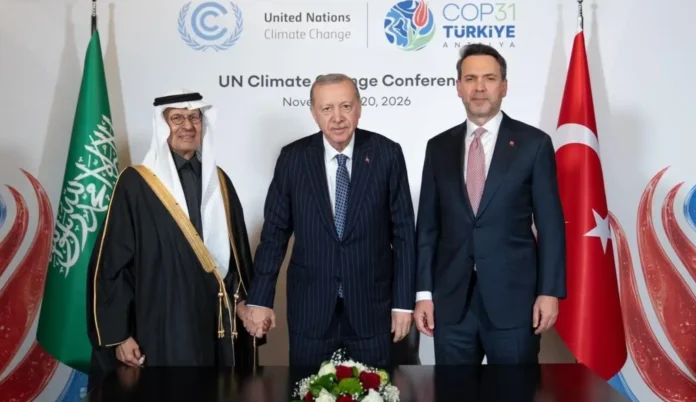
Saudi Arabia and Türkiye have agreed to develop 5,000 megawatts of renewable energy capacity, strengthening cooperation between both countries. The agreement establishes a framework for major Renewable Energy Projects while supporting Türkiye’s growing electricity needs.
The two governments signed a memorandum of understanding during the 31st United Nations Climate Change Conference, known as COP31, in Antalya. The signing took place in the presence of Turkish President Recep Tayyip Erdoğan.
The memorandum builds on an earlier renewable energy cooperation agreement signed on February 3. That agreement entered into force on October 21, 2023, providing the foundation for further investment and project development.
Türkiye faces increasing electricity demand as its economy and energy requirements continue to expand. According to its Ministry of Energy and Natural Resources, electricity consumption could reach 510.5 terawatt-hours by 2035. In comparison, the country recorded consumption of 364.8 terawatt-hours in 2025.
Meanwhile, Türkiye’s installed electricity generation capacity reached 127,355 megawatts by the end of September 2026. However, meeting future demand will require additional generation facilities and improvements to the national electricity network.
The country also aims to increase its combined solar and wind capacity to 120 gigawatts by 2035. This represents a substantial expansion from approximately 30 gigawatts when officials announced the target in 2024. Consequently, international investment and modern transmission systems will play important roles in achieving this objective.
Under the new agreement, Saudi-backed ACWA Power will implement the 5,000-megawatt development programme in two phases. The first phase will deliver 2,000 megawatts of renewable energy capacity. The second phase will add another 3,000 megawatts, expanding the programme considerably.
According to the announcement, developers have already made progress on the first-phase projects. Furthermore, preparations for the second phase have reached an advanced stage, bringing the wider programme closer to implementation.
The second phase will include wind power plants alongside high-voltage direct current transmission infrastructure. It will also incorporate battery energy storage systems to improve electricity distribution and grid flexibility. Together, these technologies can help Türkiye manage renewable generation and strengthen network reliability.
Beyond increasing generation capacity, the investment aims to improve the country’s ability to integrate renewable electricity. Better storage and transmission infrastructure can also support a more flexible national energy system. In addition, the agreement creates opportunities for deeper investment and economic cooperation between Saudi Arabia and Türkiye.
ACWA Power already operates in Türkiye through its 927-megawatt Kirikkale independent power plant. The facility represents the company’s first investment in the Turkish energy market. Valued at approximately $930 million, the plant reportedly offsets around 1.8 million tonnes of carbon dioxide emissions annually.
The existing facility provides an established foundation for ACWA Power’s expanding presence in Türkiye. Meanwhile, the new Renewable Energy Projects could significantly increase the company’s contribution to the country’s electricity sector.
Overall, the agreement connects Saudi investment with Türkiye’s long-term energy ambitions. Its implementation will depend on advancing the two phases and developing the supporting infrastructure. As electricity consumption rises, both governments are seeking opportunities to strengthen energy security and expand renewable generation.
