
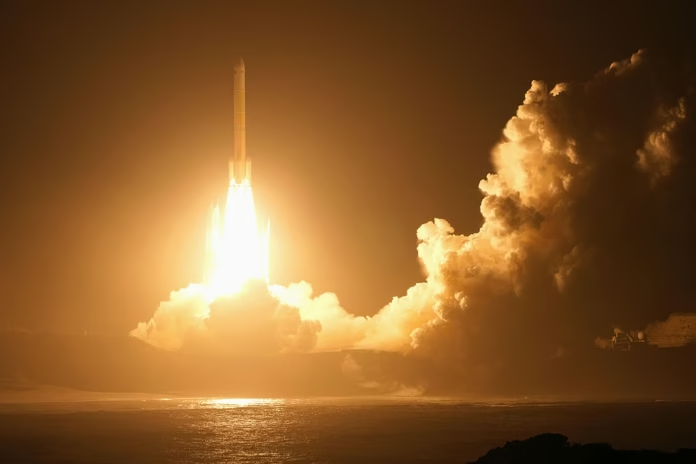
Martian Moons Exploration officially began following a successful rocket launch from the Tanegashima Space Centre in Japan. The unmanned spacecraft embarked on an ambitious journey to collect surface samples from the largest moon of Mars. Engineers confirmed that the probe separated cleanly from the launch vehicle after reaching initial orbit. Consequently, global space agencies eagerly await crucial scientific data regarding early solar system formation history.
Meanwhile, mission control teams confirmed normal spacecraft operations as the probe established initial communications with ground controllers. The robotic explorer will arrive in orbit around Mars around August 2027 to begin observations. Furthermore, European partners contributed a specialized compact rover named IDEFIX to navigate the rough surface terrain. Therefore, ground controllers will deploy the rover to survey physical landing conditions prior to sample collection.
Additionally, scientists expect the collected samples to resolve long-standing debates regarding the origin of Martian satellites. One leading theory suggests a massive ancient impact created the two lumpy outer moons billions of years ago. Alternatively, gravitational forces might have captured drifting asteroids during the early formation phase of the planetary system. Consequently, laboratory analysis of returned surface material will clarify planetary evolution models for future scientific generations.
Furthermore, Martian Moons Exploration will evaluate the physical environment for eventual human landing missions near Mars. The spacecraft will collect ten grams of surface material before beginning its return voyage back toward Earth. Meanwhile, scientists plan multiple close flybys to analyze the smaller neighboring satellite during orbit operations. Therefore, international space programs view the moon surface as a potential future staging ground for crewed operations.
In conclusion, international collaboration between space agencies continues to advance deep space research capabilities for future generations. Furthermore, returning pristine physical samples from distant solar system bodies provides invaluable geological information for planetary researchers. Moreover, robotic technology deployment paves the way for safe human deep space exploration missions in coming decades. Consequently, global scientific organizations celebrate this milestone achievement as deep space exploration enters a promising new era.
