
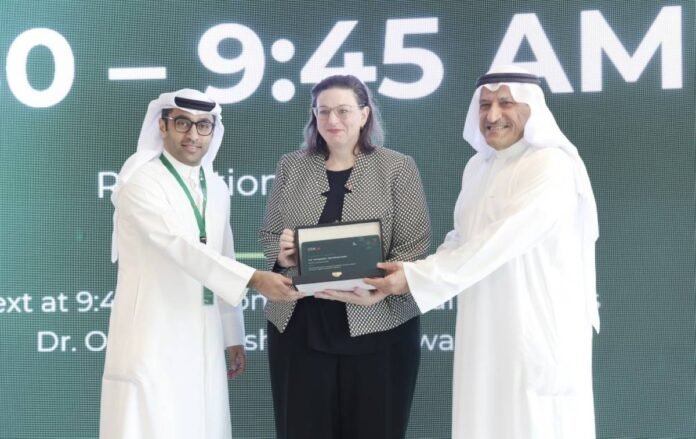
Education Innovation took center stage at the CCK–TEFL Kuwait Conference 2026, which concluded on October 18. Hosted by the Canadian College of Kuwait in partnership with TEFL Kuwait, the event gathered educators and researchers. Participants came from Kuwait, the Gulf region, wider MENA, Asia, and North America.
The Private Universities Council provided patronage, while the Kuwait Foundation for the Advancement of Sciences supported the conference. Together, these institutions helped create a platform for discussing emerging educational priorities and professional development. Furthermore, the international attendance highlighted Kuwait’s role in regional academic exchange and innovation.
Othman Boodai, chairman of the Canadian College of Kuwait’s Board of Trustees, opened the conference with welcoming remarks. Dr Jassem Mohammed Al-Ali, Undersecretary-General of the Private Universities Council, also addressed participants. Special addresses followed from guest of honor Shaikh Mohammed Ahmed Al-Sabah, chairman of AAIoT, and Rana Khan, president of TEFL Kuwait and the event’s lead organizer.
Dr Khalid Al-Begain, president of KCST, contributed a recorded message about collaboration between education, research, and emerging technologies. Meanwhile, distinguished guests included Tara Scheurwater, Canada’s ambassador to Kuwait, and Dr Bassam Alfeeli. Alfeeli serves as acting chief science outreach officer at the Kuwait Foundation for the Advancement of Sciences.
The program featured keynote speeches from Dr Stavros Hadjisolomou, Dr Zainab Almeraj, and Dr Okon Effiong. In addition, internationally recognized scholars delivered featured presentations throughout the conference. They included Dr Rita E-Haddad, Dr Christopher Hastings, Dr Plamen Kushkiev, Dr Wafa Zoghbor, Dr Fajer Bin Rashed, and Dr Kay Gallagher. Dr Naghameh Babaee also contributed as a featured virtual speaker.
Across numerous concurrent sessions, participants examined how artificial intelligence could support teaching and learning. Discussions also covered digital literacy, assessment methods, and academic integrity. Moreover, speakers explored multilingual education, learner autonomy, and innovative classroom practices that respond to changing educational needs.
The sessions highlighted AI’s potential to transform educational delivery and support new approaches to learning. However, participants also emphasized the importance of human judgment, ethical responsibility, and meaningful interaction. Educators discussed the need to balance technological tools with critical thinking, creativity, collaboration, and other essential skills.
Education Innovation also shaped conversations about preparing students for an increasingly digital and interconnected world. Participants exchanged practical ideas and approaches that educators could adapt to their own learning environments. In addition, discussions encouraged collaboration between academic institutions, researchers, and professionals working across different educational settings.
The conference provided opportunities for international knowledge exchange and professional networking. By bringing together participants from different regions, organizers created space for comparing experiences and exploring shared challenges. Consequently, the event connected local educational priorities with broader international developments in teaching and technology.
Organizers presented the conference as a contribution to Kuwait’s educational development and regional academic engagement. Its focus on emerging technologies reflected growing interest in preparing learners for changing workplace and social environments. At the same time, the discussions stressed that technology should complement effective teaching rather than replace human-centered education.
Education Innovation remained a central theme throughout the conference, linking AI discussions with teaching quality and international cooperation. The event concluded with an emphasis on practical learning strategies, ethical technology use, and continued professional development. These priorities provided a shared framework for educators seeking to prepare students for future challenges.
