
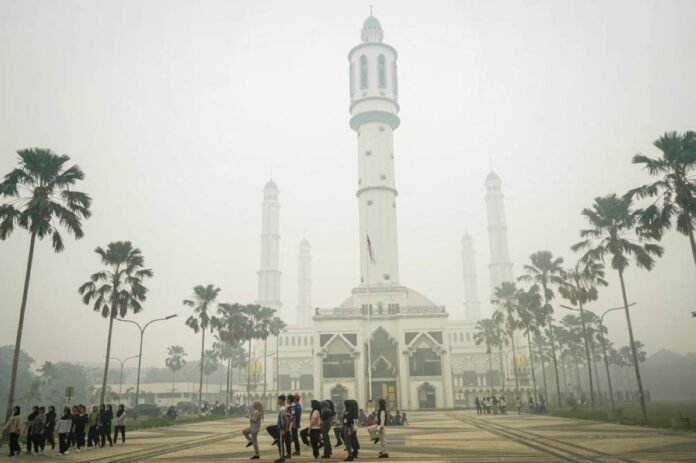
Indonesia Wildfires have burned extensive forest and peatland areas, spreading thick haze across several parts of Southeast Asia. The fires have continued for weeks, affecting communities, wildlife and air quality across Indonesia and neighboring countries. Meanwhile, authorities have launched firefighting operations while the president ordered a new agency focused on peat ecosystems.
Government figures show that fires burned more than 202,000 hectares between January and July. That figure represents roughly three times Jakarta’s area and marks a 69 percent increase annually. However, officials have not updated those figures since July, while satellite monitoring indicates continued growth.
The Nusantara Atlas monitoring project estimated that nearly 896,000 hectares had burned by the end of August. That area exceeds five times the size of Greater London, according to the satellite-based assessment. South Papua recorded particularly severe damage, with more than 168,000 hectares affected by August.
Local reports also indicated that fires appeared inside a large government food estate project. An environmental organization reported detecting fires within parts of the South Papua development. Authorities continue assessing the fires as the region faces widespread environmental damage and persistent smoke.
Weather conditions have contributed to the worsening fire situation across Indonesia during the current dry period. The El Nino climate pattern typically produces drier conditions, increasing the risk of fires across vulnerable landscapes. The current cycle could rank among the strongest experienced in decades and continue into early 2027.
However, experts have emphasized that weather alone does not explain the scale of the fires. Human activities, including slash-and-burn land clearing, remain important factors behind many incidents. Decades of forest degradation have also weakened ecosystems that previously resisted fire more effectively.
Peatlands create additional challenges because they contain thick layers of partly decomposed organic material. These ecosystems normally remain waterlogged, but drainage for agriculture has made many areas significantly more flammable. Once peat catches fire, flames can continue smoldering underground and reignite after appearing extinguished.
During the first eight months of the year, authorities and environmental groups detected more than 212,000 hotspots. Those hotspots occurred across peat ecosystems throughout Indonesia, exceeding twice the number recorded during the strong El Nino of 2015. Consequently, firefighters face difficult conditions when attempting to contain fires across extensive peatland areas.
Indonesia has deployed firefighters and volunteers across affected regions as authorities work to contain the spreading flames. Crews have also used cloud seeding and water bombing operations, although those efforts have produced limited results. Meanwhile, Malaysia and Japan have offered assistance as the regional haze continues affecting neighboring areas.
Authorities have also taken legal and administrative measures against companies linked to the fires. Officials revoked permits belonging to five companies accused of contributing to the burning. In addition, authorities froze the permits of dozens of other companies during ongoing investigations.
President Prabowo Subianto recently ordered the creation of a new agency overseeing tropical peat and mangrove ecosystems. The agency will also focus on preventing fires and improving management of vulnerable landscapes. Indonesia previously operated a similar institution following the severe fires that struck the country in 2015.
That earlier agency initially focused on peatland management before expanding its responsibilities to include mangrove ecosystems. However, its mandate expired in 2024 without renewal, leaving Indonesia without the same dedicated structure. The government now plans to establish another agency addressing peatlands, mangroves and fire prevention.
The proposal has nevertheless prompted questions about whether a new institution will address existing management problems. Environmental campaigners have called for a clear mandate focused on improving peatland protection and preventing repeated fires. They have also stressed that creating another government structure alone may not resolve longstanding environmental challenges.
The fires have already produced significant consequences for public health in affected Indonesian provinces. The health ministry reported more than 170,000 respiratory illness cases in haze-hit areas across Sumatra and Borneo. Medical concerns have therefore increased alongside deteriorating air quality and continued exposure to smoke.
Wildlife has also faced severe threats as fires spread through forest habitats across the country. Indonesian authorities rescued 100 animals from fire-affected areas, including 53 orangutans, according to a forestry official. Fires have also reached habitats containing a significant share of Borneo’s orangutan population.
Beyond Indonesia, the haze has affected neighboring countries and disrupted daily activities in several areas. Malaysian Borneo has experienced particularly noticeable effects, with schools closing periodically because of worsening smog. Singapore has also experienced haze, while air quality deteriorated in parts of the Philippines and southern Thailand.
Indonesia Wildfires therefore remain both an environmental and regional public health concern as authorities continue firefighting efforts. The scale of the burned areas has increased pressure on Indonesia to strengthen fire prevention and peatland management. At the same time, Indonesia Wildfires have demonstrated how local fires can create consequences extending beyond national borders.
