
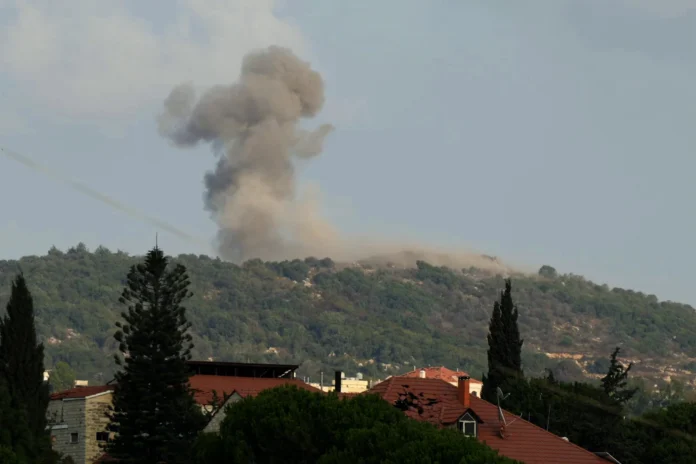
Israeli strikes killed four people in southern Lebanon on Sunday after Hezbollah launched drones toward Israeli soldiers, Lebanese officials said. Lebanon’s Health Ministry reported that the attacks also wounded 20 people across several locations in the country’s south. Among those injured were three children and several women, according to the ministry’s initial figures.
Two people died in Nabatieh al-Fawqa, while two women lost their lives in nearby Arab Salim. The strikes came after Hezbollah launched two drones toward Israeli military personnel operating near the Lebanese border. Israel said none of its soldiers suffered injuries during the reported drone incident.
The Israeli military described the drone launches as a violation and said its forces responded with attacks against Hezbollah-linked positions. Israeli authorities also issued an evacuation warning to residents of Arab Salim before additional strikes. The military told residents to leave because forces planned to target a Hezbollah facility located nearby.
Residents in southern Lebanon have faced continued uncertainty as fighting persists along the border between Lebanon and Israel. Meanwhile, Israeli forces continue operating within a self-declared security zone along sections of the frontier. The zone extends roughly 10 kilometers into Lebanese territory from the international border.
The latest escalation comes after months of fighting involving Israel and Hezbollah, which intensified during the broader regional conflict. Hezbollah, an Iran-backed Lebanese armed group, launched attacks against Israel before Israeli forces responded with extensive military operations. Lebanon says those operations have killed more than 4,300 people since the conflict expanded in March.
However, the intensity of fighting has declined compared with earlier stages of the conflict. A US-Iran memorandum of understanding in June helped reduce violence surrounding the wider regional confrontation. Later that month, Israel and Lebanon also reached a framework agreement intended to support a reduction in hostilities.
Despite those developments, exchanges between Israeli forces and Hezbollah have continued in southern Lebanon. The latest confrontation demonstrates the fragile nature of the situation along the border. Consequently, communities near military positions remain exposed to renewed attacks and evacuation orders.
The strategic Ali Taher ridge has also emerged as an important location in the continuing military confrontation. Israeli forces said Friday that they had taken control of the elevated ridge during their operations in southern Lebanon. The area rises approximately 600 meters above sea level, giving forces operating there significant visibility across surrounding terrain.
Security sources have previously described the ridge as an important Hezbollah position within southern Lebanon. According to those accounts, Hezbollah established underground facilities and weapons storage areas around the strategic location. Analysts have also identified the ridge as a useful position for launching short-range missiles and drones toward northern Israel.
Furthermore, the ridge connects several border areas with the hilly Iqlim al-Tuffah region farther north. That area has historically served as an important logistical and operational corridor for Hezbollah. Control of the ridge therefore carries significance for both military positioning and movement across southern Lebanon.
The latest Israeli strikes have added further pressure to communities already affected by displacement and repeated violence. Arab Salim residents received evacuation instructions as Israeli forces prepared for additional military action. Local authorities continue monitoring casualties and damage following the attacks.
Lebanon’s government faces continued challenges as military activity affects civilian communities across the southern region. At the same time, Israel says it will continue responding to attacks that threaten its forces. Hezbollah has continued operating despite the broader efforts to reduce regional tensions.
Israeli strikes therefore remain part of a wider cycle of attacks and retaliation along the Lebanon-Israel border. The latest casualties highlight the continuing risks faced by civilians despite recent efforts to reduce hostilities. Further developments will depend on whether both sides can prevent additional escalation in the coming days.
