
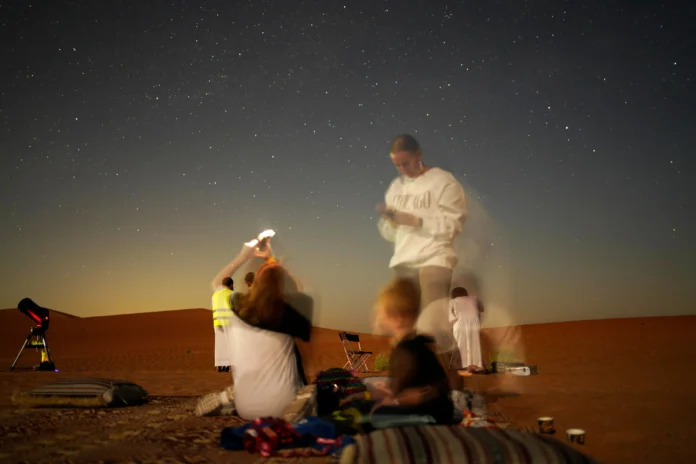
Astronomy enthusiasts in the United Arab Emirates are travelling deep into the Al-Quaa desert to experience one of the country’s clearest remaining views of the night sky, far from the glare of rapidly expanding cities.
Volunteers from the Dubai Astronomy Group have been organising guided evening trips in the desert, where participants gather to observe stars, meteor trails and distant galaxies under dark skies rarely visible in much of the Gulf region.
The initiative comes as urban development and heavy artificial lighting continue to affect visibility across the Emirates. Researchers have previously identified the UAE as one of the world’s most light-polluted countries, with most residents unable to clearly see the Milky Way from urban areas.
Located southeast of Abu Dhabi near the road leading toward Al-Ain, Al-Quaa has become known among astronomy enthusiasts as one of the country’s best locations for stargazing. Visitors travelled along desert tracks before settling among the dunes for late-night observation sessions.
Families and residents from different nationalities gathered on carpets spread across the sand while volunteers explained constellations and demonstrated telescope viewing techniques. Some participants used mobile phones to capture long-exposure photographs of the night sky, while others watched meteors streak across the darkness.
Sheeraz Awan, general manager of the Dubai Astronomy Group, said the experience encourages people to reflect on humanity’s place within the universe and reconnect with traditions long associated with desert life in the Arabian Peninsula.
For generations, Bedouin communities relied on the stars for navigation across vast desert landscapes before modern infrastructure transformed the region’s environment and skyline.
The excursions also highlight growing regional interest in environmental awareness and dark-sky preservation as Gulf cities continue balancing rapid urban expansion with efforts to protect natural heritage. Organisers said the best viewing conditions for the Milky Way typically occur during this period before the peak summer heat arrives.
