
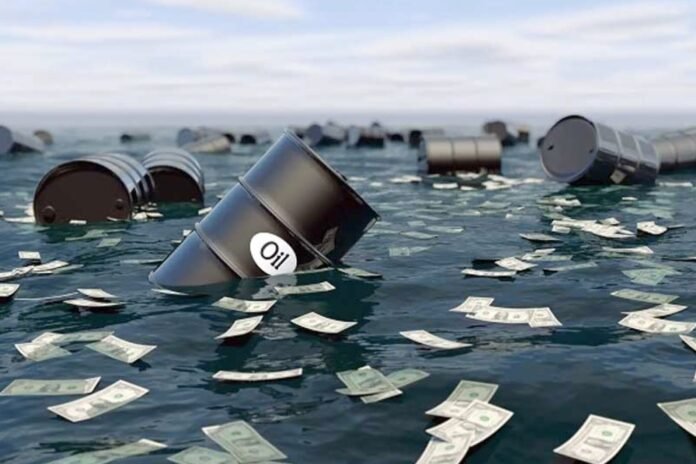
Kuwait has projected a Kuwait budget deficit of KD 9.8 billion for the 2026/2027 fiscal year, marking its third-largest shortfall since 1991. Lower oil revenues and mandatory pension transfers are driving the deficit. Moreover, government spending continues to rise, emphasizing the need for fiscal adjustments. Analysts say this projection highlights challenges for Kuwait’s long-term economic planning.
The 2026/2027 budget forecasts total revenues of KD 16.3 billion and spending of KD 26.1 billion. Spending is 6.2 percent higher than this year’s estimates. Wages and subsidies together account for 76 percent of total expenditures. The government expects subsidies to fall by 10.5 percent compared to the current fiscal year.
Oil revenues, Kuwait’s main income source, are projected at KD 12.8 billion, down 16.3 percent from this year. The government lowered the average oil price assumption to $57 per barrel from $68. The fiscal breakeven price, however, remains much higher at $90.5 per barrel, emphasizing the need for careful budget management. Oil production is expected to remain steady at 2.5 million barrels per day.
Capital spending on development projects will increase by 36.8 percent to KD 3.1 billion. Although this is a boost, it still represents just 11.8 percent of total spending. Higher corporate taxes on foreign companies pushed non-oil revenues up 19.6 percent to KD 3.5 billion this year. Non-oil revenue’s share of total income rises to 21.5 percent, compared to 16 percent previously.
The projected Kuwait budget deficit is 54.7 percent higher than this year’s estimated shortfall of KD 6.3 billion. Kuwait previously recorded its largest deficit at KD 14.1 billion in 2020/2021 due to plummeting oil prices caused by the pandemic. The second-largest projected shortfall was KD 12.1 billion in 2021/2022, though the final deficit dropped to KD 4.3 billion.
Kuwait maintained budget surpluses between 1998/1999 and 2013/2014, amassing over KD 100 billion in windfall revenues. However, consecutive deficits have returned since 2014/2015, with a brief surplus of KD 6.4 billion in 2022/2023 thanks to high oil prices near $100 per barrel.
Experts warn that the Kuwait budget deficit underscores the importance of diversifying revenue streams and controlling expenditure. With lower oil prices, fiscal reforms and strategic planning are increasingly urgent for sustainable economic growth.
