
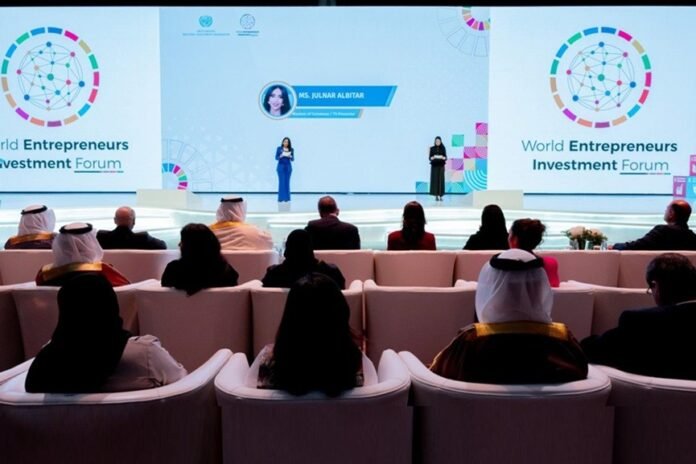
The Bahrain entrepreneurship forum entered its second day with strong international participation and ambitious goals. The event focused on innovation, partnerships, and sustainable development. Moreover, it highlighted entrepreneurship as a driver of long-term economic resilience. The forum gathered decision-makers and innovators under one platform.
The Global Entrepreneurship and Investment Forum brought together 86 delegates from diverse sectors. Participants included entrepreneurs, policymakers, academics, and financial institutions. In addition, chambers of commerce and international organizations joined the discussions. Delegates also represented Palestine, Sudan, and Syria. Therefore, the forum emphasized inclusive growth for impacted communities.
The head of the UNIDO Investment and Technology Promotion Office in Bahrain opened the second day. He stressed the need for integrated systems that support innovation. Furthermore, he linked entrepreneurship directly to achieving Sustainable Development Goals. He described entrepreneurs as agents of change and future leaders.
The agenda focused on practical outcomes rather than theory. Dialogue sessions encouraged open exchange of ideas. Meanwhile, bilateral business meetings aimed to create real partnerships. Organizers introduced a letter of intent system to document outcomes. As a result, participants could track expected investment volumes clearly.
The forum will conclude with the Sixth Manama Declaration on Entrepreneurship and Innovation. Organizers plan to submit the declaration to the UN Secretary-General. Later, the document will reach the General Assembly in New York. Consequently, the forum aims to influence global policy discussions.
Speakers also introduced a new economic approach. This strategy integrates the orange, blue, and green economies. Therefore, it supports creative industries, marine resources, and environmental sustainability. The approach seeks to unlock youth potential and encourage sustainable growth.
Bahrain’s experience received strong attention during the sessions. The Bahrain Development Bank highlighted its role in supporting entrepreneurs. Its leadership explained that funding rarely limits startups in Bahrain. Previously, cooperation raised $200 million quickly for private sector entrepreneurs.
The bank offers financial tools, incubators, and industrial zones. Additionally, it supports agriculture and fishing through dedicated markets. Entrepreneurs receive support from idea development to expansion. Incubation periods range from three to seven years. Consequently, startups gain structured growth paths.
The bank also applies strict monitoring of funding milestones. This ensures efficient use of financial resources. Moreover, recent data showed a startup default rate of only 3%. This figure remains far below the global average. Therefore, Bahrain’s model demonstrated strong effectiveness.
Other speakers emphasized youth empowerment and innovation ecosystems. They stressed entrepreneurship as a solution to poverty in young societies. Additionally, experts highlighted education and research as innovation foundations. Universities, industry, and government cooperation emerged as a key success factor.
The Bahrain entrepreneurship forum reflected a growing regional focus on inclusive innovation. It connected ideas with investment opportunities. Moreover, it reinforced Bahrain’s role as a regional entrepreneurship hub. The Bahrain entrepreneurship forum continues to position innovation at the heart of sustainable development.
